
Lessons from Tom Blake
The Uncommon Journey of a Pioneer Waterman (2001)

This article is from a Tom Wegener Surfboards Newsletter that was published around 2002/03. Tom’s father, Stiles Wegener, purchased the book Tom Blake: The Uncommon Journey of a Pioneer Waterman, as a gift and hand delivered it on a visit to Noosa from California that same year. The first printing in January 2001 was a limited edition of 2700 linen bound, hard cover books, produced by Spencer Croul and The Croul Family Foundation. Book number 1202 is a Wegener family treasure.
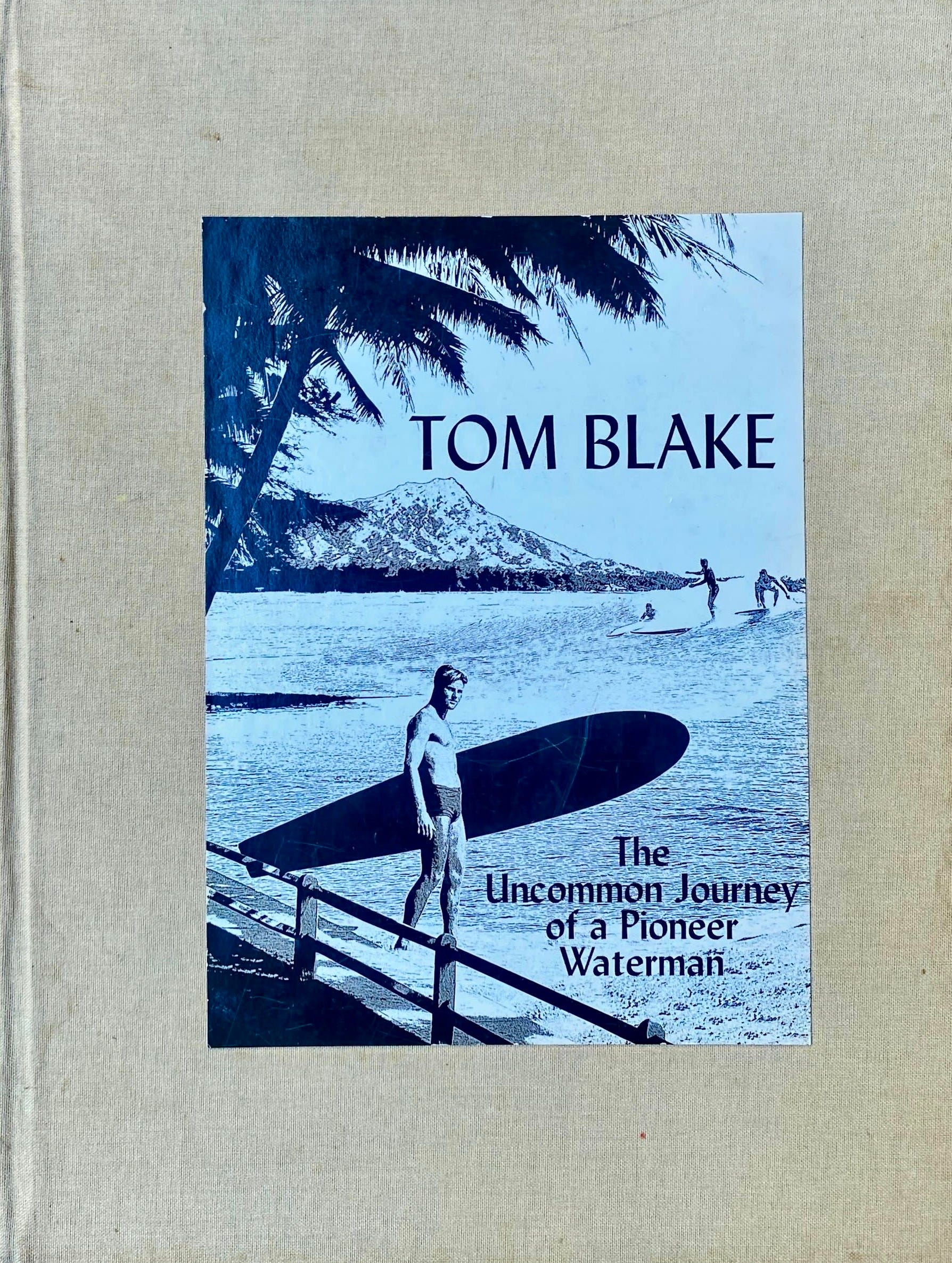
Tom wrote at the time: We have been immersed in a book about Tom Blake: The Uncommon Journey of Pioneer Waterman.
TOM BLAKE
Tom Blake surfed Hawaii and the USA from 1924 to 1955. He was a champion swimmer, an extraordinary waterman and surf craft inventor. In the early 1920s he befriended the Duke and went to visit him in Hawaii. Duke introduced Tom to surfing and Tom was hooked. There were lots of surfers at that time in Hawaii. The popular boards were made from redwood and were around ten feet long. Tom looked toward ancient Hawaiian boards that were originally 16 feet long for inspiration. There is a very famous story about Tom and the Duke from this time. The Duke was getting tired of surfing. Tom shared his new, 16 foot surfboard with the Duke and after one wave, the Duke’s surfing stoke reportedly returned. It is said many people heard his hoot after that wave!
Blake rediscovered the longboard. He invented the hollow surfboard and shattered all the previous paddle-board racing records of the time. Tom saw the lighter, hollow boards as an essential tool for lifeguards, but they also surfed well. The idea became popular over the next decade and there were now over 50,000 Tom Blake hollow boards made for lifeguards. Before the hollow boards there were but a handful of solid redwood boards in California.
Tom also invented the torpedo float for lifesaving. The float hooked on to a strap that went over the lifeguard’s shoulder. In California where I grew up, the lifeguards always had a torpedo float and strap and a paddle-board as basic life saving equipment. This was Tom Blake’s vision.
The first sail board, waterproof camera housing and water shots all developed from his vision and experimentation. Tom Blake also invented the surfboard skeg or fin. A problem with the old boards was they would slide sideways when the wave got too steep. He was the first to put a fin at the tail of the board to help hold the board in steep faces. The book notes that in his later years when he saw surfers drive with the fins on their boards he felt very proud of this innovation.
The amazing thing about Blake’s basic innovations was how unpopular they were at the time. His hollow wood boards met strong resistance for years in Hawaii. It took a decade for the fin to become an accepted part of a surfboard. The book notes the criticisms hurt him.
It seems almost human nature to resist change. For a long time the surfing press and hierarchy would not accept that longboarding was becoming popular. In the early 1980s it was inconceivable that nine foot plus surfboards would ever become popular again. Five years ago it was inconceivable that traditional, single fin longboards would have a place in the market. (Note: Remember this was written in 2002).
There is a LOT to be learnt from Blake and surfing history in general. I think we are experiencing a very good time in surfing history. With lots of different board designs and sizes to choose from, the types of waves that are considered rideable has grown. Generally, you can ride whatever you want and you will not find a hassle in the water. Not too long ago, if you were not riding what was ‘popular’ somebody would say something to foul your session. Also, the quality of surfboards has improved dramatically over the last fifteen years or so, making surfing much more enjoyable.
“Therefore we must settle for what harmony we have and enjoy, and consider the magnificent potential of body, mind and thought. For heaven on earth is a state of consciousness.” Tom Blake, Voice of the Atom (1977-88)
Footnote: Now in my 60th year I am drawn to the back of the book, where Blake’s final work, Voice of the Atom, is published. Seven chapters gleaned from his life on earth, distilled in an essence, which is Nature = God. Blake said the work, “Provides a ready framework for human ethics.” In his lifetime, Blake was an early adopter of vegetarianism. He was dedicated to a lifestyle of personal health and fitness, immersed in nature. Again, all ahead of his time.
THOMAS E BLAKE 1902 - 1994