
Surfing a Toothpick
The glide is intoxicating.

We just returned from almost a month travelling in China. It was our first time visiting this part of the world and it was an extraordinary and gratifying experience. The surf community of Hainan welcomed us like surfing family. We staged a footpath workshop at Classic Malibu China with a day-long shaping class making paulownia wood bellyboards and Alaias. The next day we surfed the boards at the local break with a crew of about twenty-five. The local surfing community has gravitated to Hainan largely from all over China and Mongolia, drawn by the tropical waves and laid-back lifestyle. Hainan is known as ‘China’s Hawaii’ and is a popular destination for domestic tourists.
Surf culture is alive and thriving. We met great watermen and women, chargers, shapers, artists of all disciplines and working professionals who just love to surf whenever they can. What surprised us most was the local shaping scene and the flourishing wood board makers. We visited many highly skilled shapers, doing their own thing. It was impressive.
The surf was mostly small and we missed two typhoon swells. The South China Sea has seen a lot of typhoon action in 2025. There is no shortage of surf and we could see the opportunities for great waves. I couldn’t help but wish I had my toothpick with me. Which brings me to this story.
I love surfing toothpicks. The glide is intoxicating.
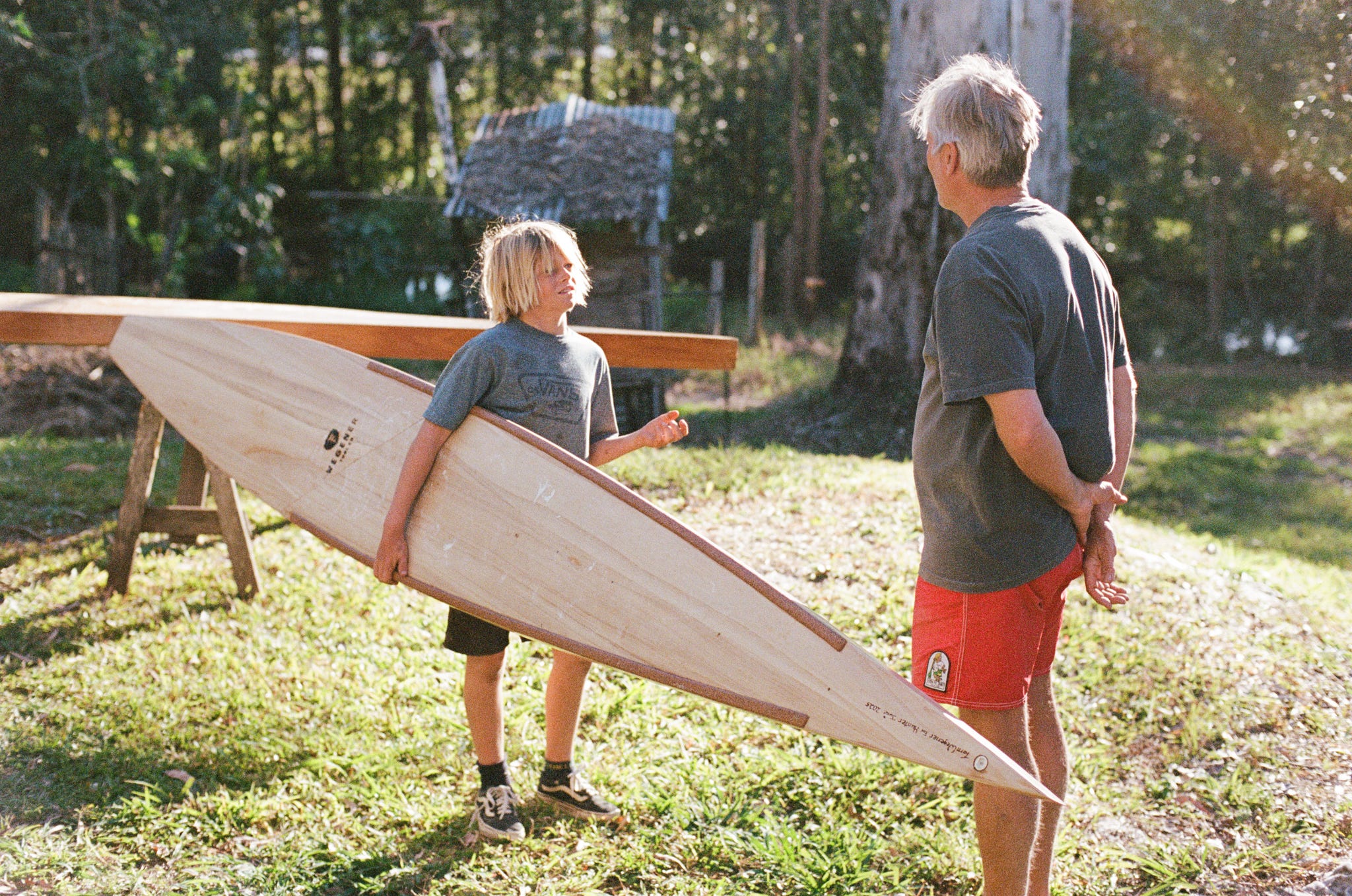
A few months ago, one of Noosa’s most talented surfers, ten year old Hunter Williams, rode my 16-foot toothpick. He surfed it beautifully. He was so stoked he wanted to make one. I had actually promised him a toothpick one year earlier.
At a campaign event for my council re-election in 2024, Margie and I organised a A Contest of Ideas and had the kids participate. Hunter’s idea for a Surfboard Library in Noosa (where you can borrow surfboards, like books, and return them) won the contest and I promised to donate a Toothpick to get the library started. Now I had to live up to my promise!
The traditional way of making toothpicks from a frame, like a wood airplane wing, is difficult. It looks easy, but it is not. I decided to make this one from an EPS core and glue layers of 2mm paulownia over the top. The legendary paddle board racer, Noosa’s Lachie Lansdown, had given me an old board which I stripped back to foam. It was one of his favourite old boards and I thought by saving the core I could transfer the old mana to the new board.
I quickly discovered that pulling the glass from a long paddle-board is also difficult but in a few hours I had a blank to shape.

The outline of a toothpick is made from bending long sticks of wood. I call these boat curves and they are pleasing to the eye. I made a template that would fit under a 10 year old’s arm and figured the end board would be 3 inches thick. It is a scaled down version of my 16 foot Bill Wallace design. The key feature is the roll through the bottom of the board. The roll pulls the board into the wave and lets the board angle across a swell without sliding sideways. The faster you go, the more suction from the rolled bottom and the steadier the ride. However, more roll may grab the wave too much, sucking the board into the lip. Because Hunter does not weigh much, I shaped more roll, so the board would stick to the wave. Also, Hunter is such a good surfer, he could cope with the grab from the extra roll.

Gluing the 2mm thick sheets of paulownia to the board is easy. The thin wood can glue over complex curves so the board has a rolled bottom and rocker through the nose. I put strips of cork down the sides of the deck because the hard square rail gets uncomfortable. The soft, rounded cork saves the insides of your legs.
We waited several weeks for the perfect day to get the new board in the water. Finally the conditions came together with glassy, waist high Noosa and very long fast peelers. Perfect for testing the speed of a toothpick! We could catch the swell and set an edge as the wave hollowed out over the sandbank mere inches below. The magic of the toothpick is that it continues to accelerate where finned boards hit their hull speeds. Hunter’s eyes were opened to an entirely new surfing experience.
Hopefully Hunter’s Surfboard Library will become a reality and other young surfers will be able to try this magic little Toothpick.
Recycling Old Surfboards
This was the first time in many years that I shaped a new board from old foam. When we were young, back in the late seventies, we would reshape old discarded surfboards. There were a lot of transition surfboards, left over from the fast-moving shortboard revolution. We reshaped the old foam into mostly single fin pintails and re-glassed them.
I am looking at the amount of landfill generated by foam surfboards and I see foam waste as a valuable resource. Using 2 mm sheets of paulownia and the Corky Method this foam could be repurposed to make new boards! More to come…
Video and film photos by Samuel Fairbank
Love that creation tom.